
Moai, Myths, and Miles: A Three‑Night Introduction to Rapa Nui
Rapa Nui makes you work a little to get there, and then immediately slows you down once you arrive. Consider this the practical side of a place that’s equal parts logistics, lava rock, and quiet awe
3/25/20266 min read
SUMMARY
Towering Moai statues, some still trapped in the earth in the abandoned quarry. Others standing sentinel, facing the island and its people they were erected to protect. Rapa Nui—also known as Easter Island—was full of mystery and small, magical moments. Three nights was the perfect amount of time to explore several sites on the island while still having space to slow down amid the sunshine and tropical breezes.
DETAILS, DETAILS, DETAILS
Visiting Rapa Nui isn’t something you decide on a whim. Flights only depart from and return to Santiago twice per day, and the island sits alone in the Pacific, 5 hours away and a two-hour time difference from the mainland. You must fill out a visitors form and get it stamped in a separate security line or you can’t board the flight—an easy detail to miss, judging by the number of people in the Santiago airport who end up backtracking through security with a look of mild panic. A licensed guide is required to enter the national park, which covers most of the island, and a 10-day park pass costs about $100 (no shorter options exist). This requirement for a guide negates the need for a rental car; your tour guide will provide transportation for your private or group tour.
Travel tip: LATAM is the only airline flying to Rapa Nui, and booking on the Chilean version of their website can save you a surprising amount of money. Change the URL to https://www.latamairlines.com/cl/es and stay on the Chilean site when prompted. Everything will be in Spanish, but a browser translator works fine. All future emails will also be in Spanish, so be prepared for that. I booked round-trip business class for the same price the US site was charging for economy.
Fresh fruits and some vegetables are grown on the island, but most other produce is imported. Sheep and cattle ranches supply meat, and seafood comes straight from the Pacific. The cuisine is a mix of Chilean and island flavors, with western dishes like pizza and pasta also available. Ceviche is abundant and fresh, and whole pineapple is served on a stick. The island has a relaxed, unhurried vibe that makes you slow down whether you planned to or not.
MY ITINERARY
I spent three nights and four days exploring the island. The early flight lands just after noon, and most accommodations send someone to meet your flight and take you to your hotel, cabana, or guest house. You could walk to the airport from town in about 15 minutes, but being greeted by name with a smile and a flower lei is far more pleasant. Local musicians and dancers were performing for the incoming flight. The airport is tiny—essentially a covered walkway leading to a small building with security belts, a few souvenir shops, and a café.
I had plenty of time to relax when I arrived, as my two-day plus sunrise tour wasn’t starting until the next morning. I stayed in a three-cabana property on the main street, just a block from the marina. There are many accommodation options—from the ultra-luxury, all-inclusive Explora Rapa Nui to hostels with shared rooms and communal kitchens. It was hot and humid in early January, and I was grateful for air-conditioning during the heat of the day before heading out to explore town and catch the sunset.
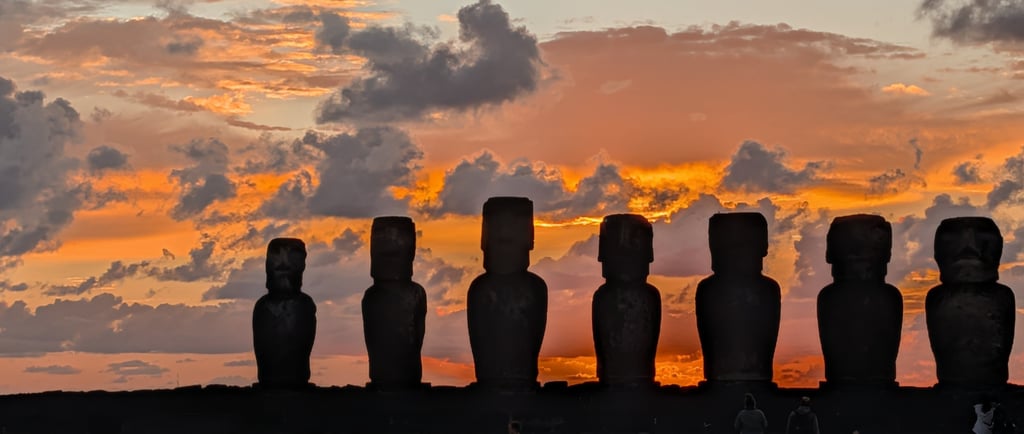
There is an Ahu, or ceremonial burial platform, with Moai very close to town that sits outside the national park. You can visit without a pass. You can sit on the grass—along with just about everyone else on the island—and watch the sun set, coloring the sky in oranges and yellows with the Moai standing quietly in the foreground. It’s a photographer’s delight and a reminder that sometimes the best moments are the simplest ones.
My tours over the next two days were fascinating. We covered a lot of ground, visited the quarry and various Ahus, and heard the stories surrounding each one. We also visited a fascinating community where the Bird Man sect flourished until a hundred years ago. My final day started pre-dawn with a return to the largest Ahu—Ahu Tongariki. This is the place to watch the sunrise. While you can get a good view from the road without entering the national park, sitting directly in front of the statues as the sun rose behind them felt worth the early alarm.
I was on the first of two returning flights, departing just after 2 p.m., so I had plenty of time to rest and enjoy more time in Hanga Roa, the island’s only town. I sat in the shade of a Moai at the marina and soaked up the peace and quiet of a Sunday morning. My cabana host then drove me the short distance to the airport, and I was off to Santiago, arriving after 9 p.m.
Travel tip: The early return flight lands around 9:30 p.m. and the late flight closer to midnight. Staying at the Santiago (SCL) airport is the easiest option. The Holiday Inn is connected to the terminal by a walkway that takes about three minutes to cross. Several other hotels are within a five-minute drive and are very used to late arrivals.
ALL ABOUT MOAI
Rapa Nui has a fascinating history. My guide broke it down like this:
The migration of the Rapa Nui people from various Polynesian islands occurred around 900 AD.
The Pre-Moai chapter had altars where ashes of ancestors were buried but no statues.
The Moai chapter lasted hundreds of years and was marked by increasing size and sophistication of carving.
The Bird Man chapter ended the Moai period quickly and decisively.
The statues first appeared in the 12th century and served as envelopes for the souls of kings or high-ranking clan leaders. This is why all but one of the Ahus faces inland; they serve to protect the clan and bless them with favorable crops and weather. The height and adornment of each statue honored ancestors and signaled power to other clans. The statues were carved from the quarry and moved into place atop the Ahu. They remained inert stone until the coral eyes were placed into the sockets—only then were they spiritually activated and imbued with ancestral mana.
All the Moai on every Ahu were toppled—literally overnight—by the newly formed Bird Man sect. It was believed the Moai were no longer protecting the clans and were reinforcing an unfair hierarchy. The 398 statues at the quarry were left untouched because, without eyes, they had no spiritual power. They were unfinished stone, not yet vessels for ancestral protection.
Some Moai remain toppled, while many others have been restored, though no eyes were ever found. Some believe they were hidden to protect the ancestors’ souls, but no one knows for sure. A massive tsunami in the 1960s caused further destruction, marking the last major archaeological excavation and restoration. The island now focuses on preservation and education.
THE BIRD MAN SECT
Makemake was considered the island’s god in the form of a bird. The Bird Man sect rose to power in the 1800s, shifting away from hierarchical rule and toward nature. A yearly competition—the Bird Man ritual—appointed a champion from each clan to compete in a grueling, life-or-death contest. Participants scaled down a 1,000-foot cliff, swam against strong currents to a nearby island, found the first egg laid by a specific seabird, then swam back and climbed the cliff again without breaking the egg. Competitors could use any means necessary to steal the egg, including violence. The winner’s sponsor—not the competitor—became the Bird Man and ruled for one year.
The Bird Man had their head shaved, received temporary tattoos, and was isolated from the community. In reality, the shamans held the true power, using the Bird Man as a symbolic figure to placate the people. Colonization and Christianity ended the ritual; the last recorded event was in 1914.
WHEN TO VISIT
There may not be a bad time to visit and even in rain, the culture and magic of Rapa Nui would shine through. Shoulder seasons are April–June and September–October. The highest prices and crowds are December–January. February brings rain. I visited in early January, with temperatures in the upper 80s to low 90s, full sun, and high humidity. It didn’t feel overly crowded.
Travel tip: If visiting in December or January, bring plenty of sunscreen and water. An umbrella is useful for shade more than rain. There are few trees, so shade is limited.
FINAL THOUGHTS
Am I glad I made the effort to get to Rapa Nui? Definitely. It’s a beautiful island with warm, welcoming people. Most residents know one another, and the sense of community radiates everywhere. Watching them greet each other felt like being a fly on the wall at an enormous family reunion.
Photo: Ahu Tongariki at sunrise
Contact info
© 2026. All rights reserved.
Robin — independent travel advisor of Fora Travel
Washington State UBI: 605900231
Travel services are provided by Fora Travel, Inc.,
Washington State - Seller of Travel Unified Business ID (UBI) # 605329242
All client payments are processed directly by Fora Travel or the travel supplier; I do not accept or handle client funds.
Fora Travel, Inc.
228 Park Ave South #53272
New York, NY 10003-1502
+1 844-409-3672
Fora Travel Profile: https://www.foratravel.com/advisor/robin-franko
Protect you and your trip with travel insurance: generate free quotes at Arch RoamRight Insurance and Faye
Phone: +1 206 388-6389
Disclosures